
Featured
The new Simplified FAFSA is here! Here’s a quick video with some tips that will help you get through it with a minimum of chaos and maximum of financial aid. 🔗
Most recent posts
April is Financial Literacy Month, so I'm writing about some general financial literacy topics. Today's topic: Pre-Tax and Roth retirement savings and how to decide which to use.
Thinking it’s worth taking out student loans to go to your first choice college instead of your second choice? Here’s what recent college graduates have to say about their student loans.
Want to have a lot more money for college? The tax benefits of 529 plans mean you could have thousands more dollars available when the time comes to start paying.
April is Financial Literacy month, so I'm going to write about some broader topics that might be helpful to you and your student. Starting with credit scores: what are they, how do you get one, why do you care?
Highlights
We’re almost there: acceptance letters are arriving and the May 1 decision day is right around the corner. For most families, how much schools cost is part of the decision making process.
Happy 2026! Last year I made a New Year’s Resolution and kept it. That makes me a self-appointed expert on New Year’s resolutions. Here are some resolutions for parents planning for college— and my expert advice on how to keep your resolutions.
Filing the FAFSA and CSS Profile raises tons of questions for divorced parents. Here are some answers.
What is and isn’t an asset on the FAFSA? Here’s a quick “is it or isn’t it?” for you.
Parent assets seem to be the area that most families and planners focus on, despite the fact that they typically have the smallest impact on the formula of each of the components. Strategies and tactics to minimize parent assets abound, but for most families these result more in nibbling around the edges than actually making a significant dent in SAI.
The College Board’s annual Trends in College Pricing and Student Aid report was released recently. Among the headline findings: college tuition prices increased at extremely low rates for the second year in a row, reflecting both a combination of continued impacts of the pandemic and enrollment pressures from demographic trends.
Happy FAFSA Day! Are you completing the FAFSA for the first time this year? While you’re waiting for the site to load, here are some resources that will help you get through it with a minimum of chaos and maximum of financial aid.
I think Oregon is one of the last places in the US that starts school after Labor Day so my apologies if you’re no longer in back-to-school mode. Here are some resolutions your family might make for the coming school year. And, here’s hoping they don’t get broken as quickly as the typical New Year’s diet-and-exercise resolutions!
Categories
The FAFSA & CSS Profile
Saving for College
Student Loans
Application Process
Miscellaneous
All blog posts
How America Saves for College - 2018
Insights from Sallie Mae’s 2018 How America Saves for College report.
What to do this Summer
Tips on college application related things that students may want to spend some time on this summer.
Manipulation of Student Loan Default Rates
Interest Rates on Student Loans for 2018-2019
If you will be taking out loans to pay for college, you probably want to know what interest rate you’ll be paying. Unfortunately, the rates for the coming school year are not available yet. They’ll be set based on the 10-Year Treasury Note from the last auction before June 1.
Scholarships and Why You Still Need to Save
According to the College Board, about 2/3 of college students receive some form of scholarship or grant. And the NCAA doles out more than $2.9 billion in scholarships annually.
NACAC College Openings Update
Potential Changes to Federal Loan Programs
School Codes on ACT/SAT Registration
Student Loans by School
If you’ve been reading this for a while, you probably know I’m a huge fan of College Navigator as an information source. It’s run by the National Center for Education Statistics and has some information that any prospective student should be aware of.
Series EE and I Bonds
Many parents and grandparents purchase education savings bonds– series EE or series I bonds– to pay for college. These bonds are tax-free within some limits, and it’s not uncommon for families to find out too late that they’ve landed outside the limits.
Do the FAFSA. Really.
More reasons why all families should complete the FAFSA every year.
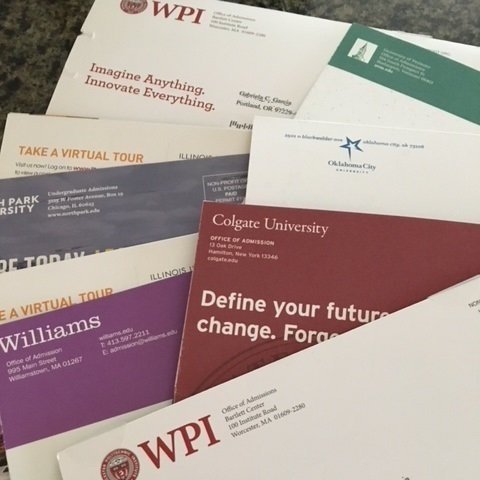
About All That Mail…
If your mailbox is starting to be overwhelmed with college and related marketing promotions, you can thank the College Board or ACT. More on that…
What’s a 1098-T?
If you have a college student, you (or they) probably received a form 1098-T. Schools are required to send this to any student who paid qualified higher education expenses. Here’s what you need to know about your 1098-T
A client’s former advisor told her that she should save $800,000 per child for college. None of my initial reactions to that were appropriate for a client meeting, but how much should you save for college is an important question for a lot of families so let’s dig into that.